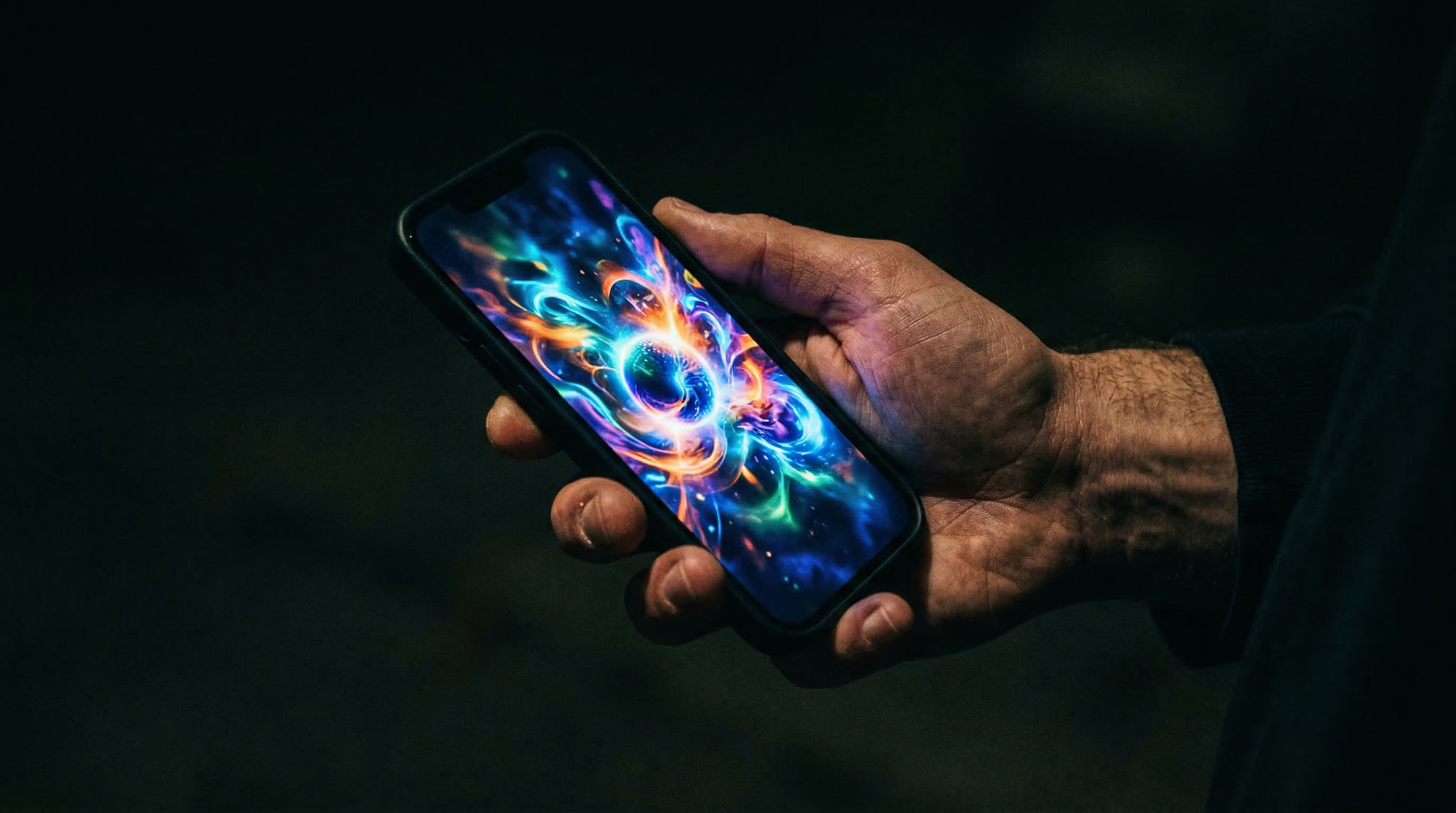
Why the visual is the ad
Meta's own research on creative effectiveness consistently points to the visual as the primary driver of ad performance. Their Creative Compass framework, which analyzes what separates high-performing ads from low-performing ones, identifies visual quality and distinctiveness as among the strongest predictors of click-through rate across verticals.1
This matches how the feed actually works. A person scrolling is making continuous, unconscious decisions about what deserves attention. The text overlay, the offer, the headline — none of these get read if the image doesn't earn a stop first.
What stops the scroll
Not all images have the same stopping power. The ones that consistently outperform share a few characteristics:
- Contrast with the surrounding feed — A very bright or very dark image in a feed full of neutral tones stands out. A bold color against an otherwise muted background gets noticed. The image has to be visually distinct from whatever is next to it.
- A clear subject at thumbnail size — The feed renders at small scale on most screens. If the key element of your image isn't legible at 300 pixels wide, it won't register. A single strong subject in frame — a face, a product, a before/after — reads faster than a complex scene.
- Visible transformation or result — Images that show a clear change from one state to another naturally pull the eye. A gleaming smile. A driveway before and after pressure washing. A freshly landscaped yard. The contrast within the image itself is what creates visual tension and interest.
- Faces and expressions — Human faces are a well-documented attentional anchor. People look at other people's faces instinctively. When it fits the ad, using a real face with a clear, warm expression consistently improves engagement.
What doesn't work as a visual hook
Stock photo imagery that looks like stock photo imagery almost never stops the scroll. People have seen these images tens of thousands of times in ads, websites, and presentations. They read as generic before they're consciously processed, and generic images get skipped.
Similarly, images that are visually busy — multiple competing subjects, complex backgrounds, text-heavy compositions — don't communicate quickly enough. The eye doesn't know where to land, so it moves on.
For local service businesses, images that look local have an inherent advantage. A pressure-washed driveway that looks like it could be in your viewer's neighborhood is more stopping than a perfect CGI rendering of one.
For local businesses specifically
Local service businesses have a specific opportunity that national brands don't. Familiarity is a hook. An image that looks like a real neighborhood, a real home exterior, a real treatment room — not a polished ad set — signals authenticity. That signal generates trust before a word is read.
This is one reason before/after creative consistently outperforms for home services, dental, and med spa: the "before" image shows something recognizable and imperfect, which reads as real. The visual tension between before and after is both the hook and the proof.
Copy works only after the visual succeeds
Your headline matters. Your offer matters. The call to action matters. But they only get processed after someone stopped on the image. If you have strong copy on a weak visual, your copy is effectively invisible.
This is the most common mistake in local business ad creative: spending significant effort on writing the perfect offer or headline while using a mediocre image that doesn't earn attention. The copy can't rescue the creative if the creative doesn't stop the scroll.
The practical implication: when an ad underperforms, the image is the first thing to examine and test, not the copy. Swap the visual before changing the headline.
The standard to aim for
A strong visual for a local service business ad should pass a simple test: if you saw this image in your feed with no text on it, would you stop and look? If the answer is yes because it shows something interesting, unusual, or visually compelling, the image can work. If the answer is maybe, keep looking for a better one.
Ad creative built to stop the scroll
AI Sidekick produces high-quality visuals for local service businesses, curated for stopping power across dental, med spa, home services, and more.
Get your free samplesSources
- Meta for Business: Creative that performs on Facebook and Instagram